Add TCM to your
physio toolkit.
Instantly.
For physiotherapists expanding into dry needling, acupuncture, or TCM. Get pattern diagnosis grounded in the classical texts, musculoskeletal-focused point selection, cupping, gua sha, and moxa protocols without years of additional study.
No credit card required
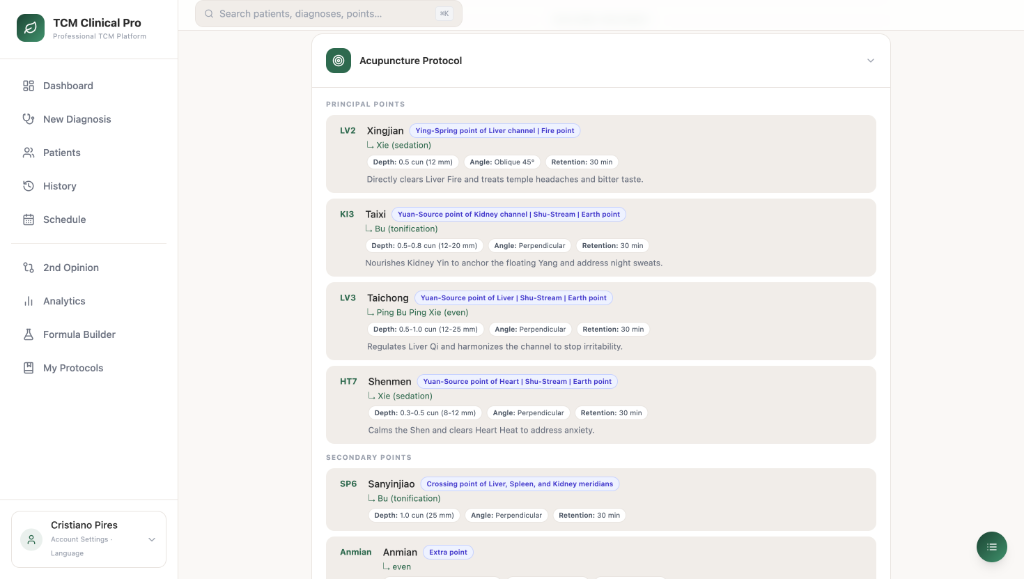
Pain Protocol: Bi Syndrome
Points, cupping areas & gua sha technique
Bi Syndrome
Pain & obstruction focus
Cupping + Gua Sha
Bodywork protocols
5 styles
Needling systems
14 days
Free trial
Pain & musculoskeletal focus
TCM pain management,
clinically precise.
Bi Syndrome Protocols
Wind-Cold, Wind-Heat, Wind-Damp, and Fixed Bi patterns, specific point selection, needling depth, technique notes, and frequency for each type.
Zang-Fu & Channel Diagnosis
Understand the systemic root cause behind pain, Kidney Yang deficiency, Blood stasis, Liver-Spleen disharmony, beyond the local symptom.
Adjunct Modalities
Cupping areas, gua sha technique, moxibustion points, and electro-acupuncture Hz/waveform pairs, all generated from the pattern diagnosis.
Everything a physio-acupuncturist needs
Clinical Synthesis Engine™
Full TCM differential from your intake data, grounded in the classical literature. No manual textbook cross-referencing required.
Point Selection with Rationale
Each point explained, what it treats, technique, depth, and retention time.
Cupping & Gua Sha
Areas, technique, frequency, and contraindications, pattern-specific, not generic.
Electro-Acupuncture
Point pairs, Hz, waveform type (dense-disperse vs continuous), and duration.
Outcome Tracking
Pain level, energy, mobility, tracked per session with visual progress charts.
Compliance Built-in
GDPR-ready. Patient consent workflows. Audit logs for each clinical decision.
diagnostic hypotheses evaluated per case
Every case is weighed against 250+ diagnostic hypotheses
This is not a lookup table. The Clinical Synthesis Engine™ cross-references your patient's full intake against the differential frameworks documented in the classical canon, then ranks the patterns that actually fit.
4
examinations cross-validated (四诊合参)
360+
acupuncture points with technique rationale
275+
Materia Medica herbs mapped to patterns
Grounded in the classical canon
The engine reasons from the seminal texts of the lineage, not from generic internet data.
Huangdi Neijing
Foundational theory of Zang-Fu and channels
Shanghan Lun
Six-stage differential frameworks
Jingui Yaolue
Classical formulas and internal patterns
Wen Bing Xue
Heat pathology at four levels
How the synthesis works
Structured intake
Symptoms, tongue, pulse, emotions and history are captured as clinical data points.
Hypothesis mapping
Each data point is weighed against 250+ candidate patterns from the classical literature.
Cross-validation
Tongue, pulse and symptoms are checked for consistency, contradictions are flagged, never hidden.
Ranked differential
You receive a confidence-scored differential with the full reasoning displayed for your review.
Every output shows its reasoning. You stay the clinician, the engine does the heavy cross-referencing.
Measured pain management outcomes
Physio-acupuncturists report improvement in just weeks.
Based on aggregated self-reported data from physiotherapists using TCM Clinical Pro for pain management:
82%
pain reduction accuracy
Bi syndrome protocols matched to correct pain pattern on first attempt
25 min
saved per session
Point selection and protocol generation vs. manual cross-referencing
91%
cupping/gua sha protocol relevance
Adjunct modality recommendations accepted as clinically appropriate
2.8×
faster pattern identification
Systemic root cause identified alongside local trigger points
74%
improved patient outcomes
Chronic pain patients showing measurable progress within 6 sessions
Based on self-reported user data. Individual results may vary. Not a clinical trial.
Inside the platform
Built for real clinical work.
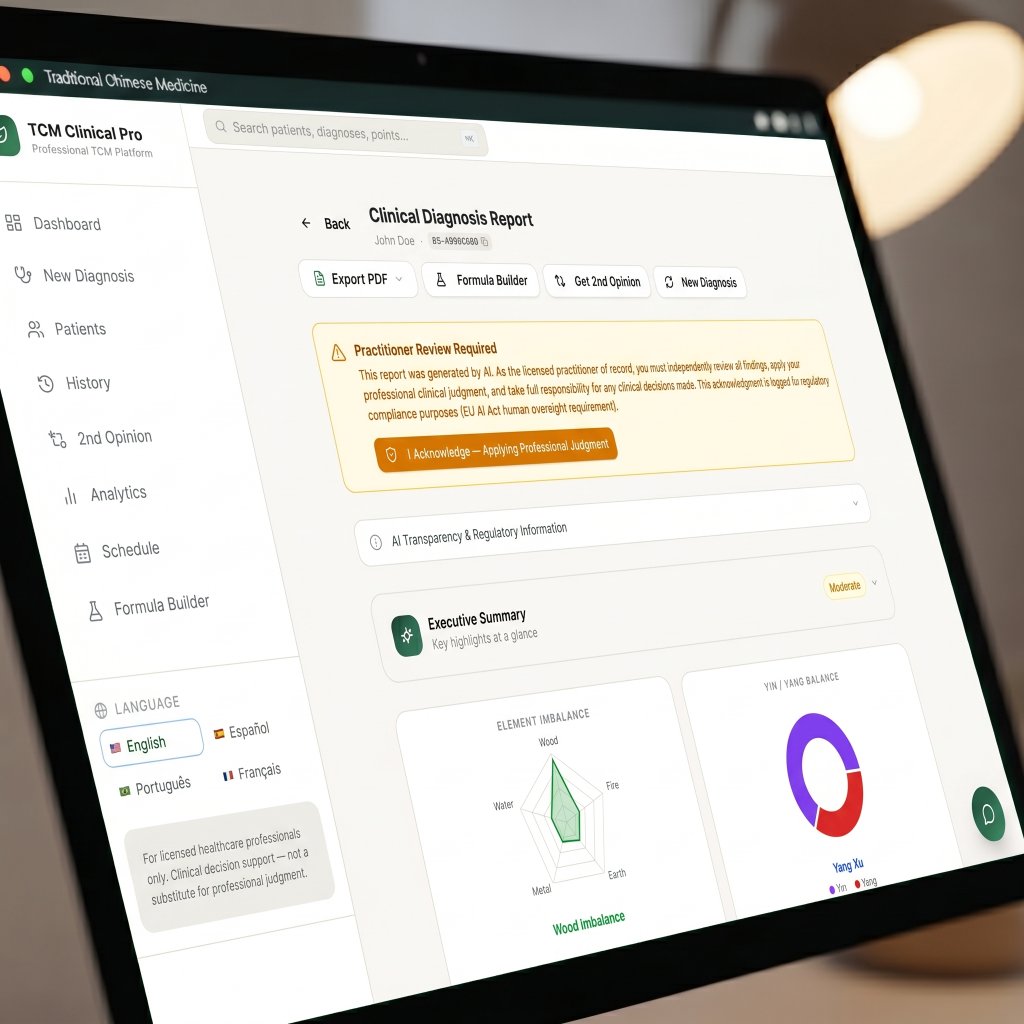
AI pattern diagnosis

Hands-on treatment
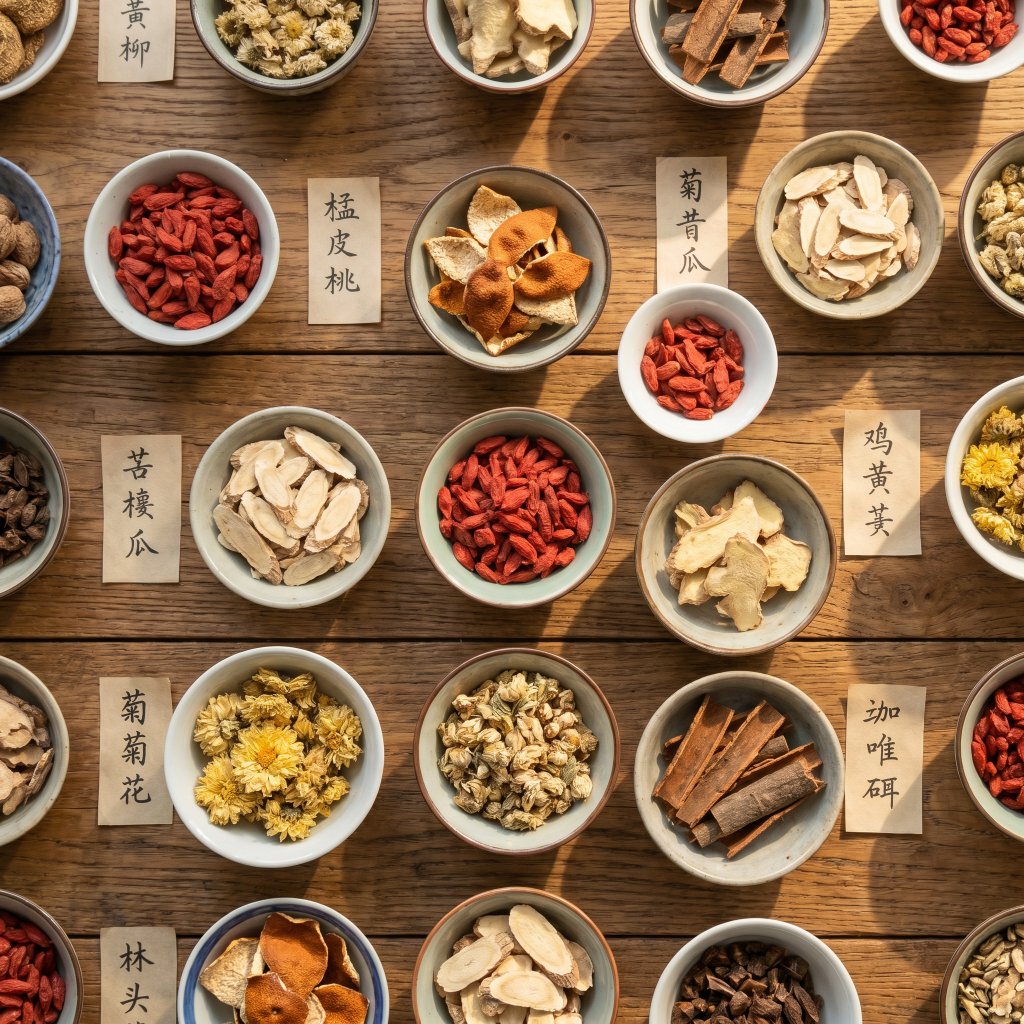
Classical herbal formulas

Patient consultation
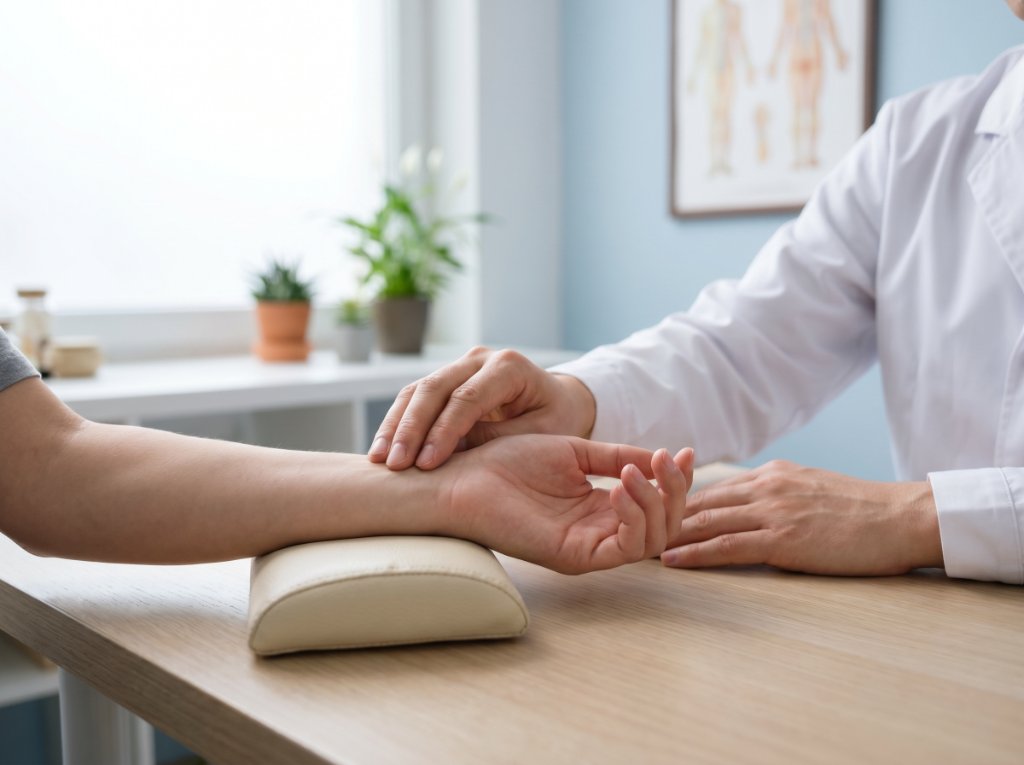
Tongue & pulse intake
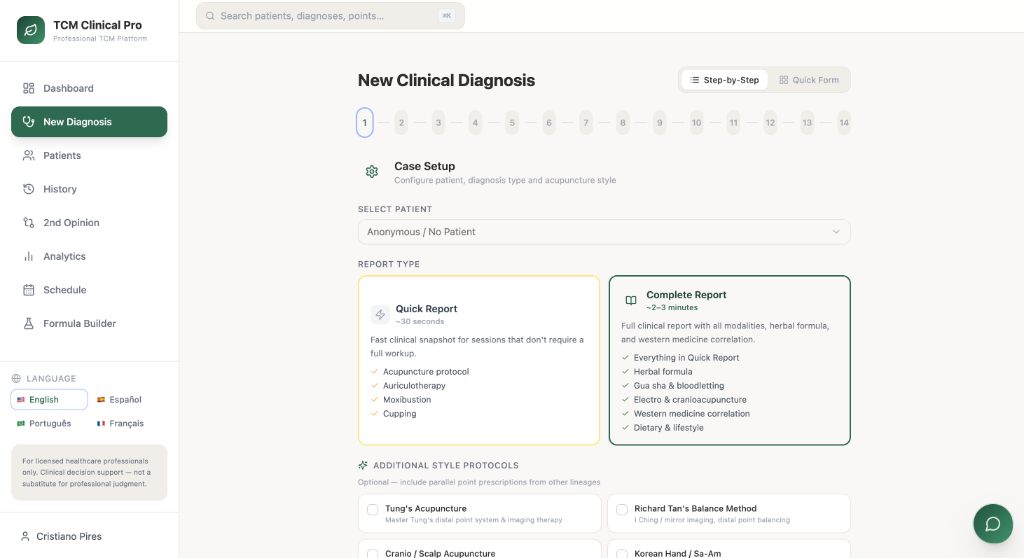
Generated reports
Trusted by US practitioners
What licensed pros across the United States are saying.
"I do a lot of dry needling. Having meridian and trigger-point overlays in one place changed how I plan sessions, and I document everything in a HIPAA-ready report."
Dr. Tyler Brooks, DPT
Summit Sports & Spine PT, Boulder, CO
8 yrs
"Clients with chronic pain want more than mobility drills. The TCM layer helps me explain why we're combining manual therapy with breathwork, and they stick with the plan."
Lauren Castillo, PT, DPT, OCS
Coastal Movement Physical Therapy, San Diego, CA
10 yrs
"The reports are clean enough to share with referring physicians. That's a big deal for cross-referral in my market."
David Okonkwo, PT, DPT
North Atlanta Performance PT, Atlanta, GA
6 yrs
Names, clinics, and locations shown above are illustrative composites representing typical feedback from US practitioners. Real names withheld to protect client privacy. Individual results vary.
Real Clinical Cases
When 'soft-tissue work' isn't enough, the cases that demand precision.
Real musculoskeletal cases where standard physio plateaued. TCM reveals the systemic pattern blocking recovery.
Case 1: The Failed Frozen Shoulder
52yo Female, 14 months of left adhesive capsulitis. Failed 3 cortisone injections, hydrodilatation, and 6 months of standard physio. Range plateaued at 70° abduction, 30° external rotation. Pain worse at night, hot flashes, irritability, lateral rib tenderness. Tongue: red with thin yellow coat on the sides, slight purple under tongue. Pulse: wiry and rapid on the left guan, deficient on both chi positions.
Diagnosis
Liver Qi Stagnation transforming into Fire (Gan Yu Hua Huo) with Blood Stasis in the Shao Yang and Tai Yang sinew channels, on a background of Liver Blood/Kidney Yin Deficiency.
TCM Reasoning
This isn't structural, it's why physio failed. The peri-menopausal Yin depletion left the sinews under-nourished; chronic emotional stagnation generated Liver Fire that scorched the shoulder collaterals, producing the inflammatory adhesion. The lateral rib tenderness and wiry left guan confirm Shao Yang involvement. Treating the capsule alone ignores the underlying systemic dryness preventing tissue compliance.
Western Correlation
Phase II adhesive capsulitis with peri-menopausal pro-inflammatory state. Recommended: MRI to confirm capsular thickening; estradiol, FSH, inflammatory markers (CRP, ESR); rule out diabetes (frozen shoulder is 5× more common).
Treatment
Distal first (open the channel before mobilizing): SI3 + BL62 (Du/Yang Qiao for Tai Yang), TE5 + GB41 (Dai/Yang Wei for Shao Yang), needle distally first, then ask patient to move the shoulder gently. Local: SI9, SI10, SI11 (look for sinew nodes), LI15, TE14. Add LV3 + LV13 to drain Liver Fire. Cupping along Shao Yang. Manual therapy ONLY after channels are opened, capsular stretch then becomes pain-free. Avoid aggressive end-range mobilization without distal needling first.
What to tell the patient
"Imagine your shoulder is like a dry leather belt that's been left in the sun for years. If you try to bend it, it cracks, and that's why stretching alone failed. We need to oil the leather from the inside before it can bend again. Once we restore the moisture, you'll be surprised how quickly it moves."
Case 2: The Runner Who Can't Land
29yo Female elite trail runner. 7 months of right anterior knee pain, normal MRI, normal X-rays. Symptoms: pain only on downhill running and stairs, occasional 'giving way,' tightness behind the knee, cold feet after training, irregular menstrual cycle (4–5 month gaps). Tongue: pale and slightly purple with thin coat. Pulse: deep and weak on the right chi, choppy on the left.
Diagnosis
Kidney Essence (Jing) Deficiency with Liver Blood Deficiency leading to undernourished sinews of the lower limb, complicated by local Blood Stasis in the Wei Zhong area (BL40) and Patellar Bi (knee 'obstruction syndrome').
TCM Reasoning
Normal imaging doesn't mean normal function. The amenorrhea (Kidney Jing depletion from overtraining + RED-S) deprives the Liver of Blood, which fails to nourish the sinews and tendons. The right chi weakness directly correlates with the right knee. The choppy left pulse confirms Blood-level stasis. The 'giving way' isn't ligamentous, it's the sinew failing under load because it lacks nourishment. Eccentric strengthening alone will worsen this.
Western Correlation
Likely Relative Energy Deficiency in Sport (RED-S) with secondary functional patellofemoral pain. Recommended: DEXA scan (bone density), full hormonal panel (FSH/LH/estradiol/AMH), ferritin, vitamin D, RMR test. Nutrition referral non-negotiable.
Treatment
Local: He Ding, Xi Yan (eyes of knee), GB34, SP9, BL40 (with light bleeding if Blood Stasis signs). Distal: SP6 + KI3 (Three Yin Crossing tonification), ST36 + SP10 (Blood). DU4 + BL23 to tonify Kidney. Moxa on lower abdomen (CV4, CV6). REDUCE training load 50% for 6 weeks. No eccentric loading until menses return. Add herbal: Zuo Gui Wan modified with Du Zhong + Tu Si Zi for sinew nourishment.
What to tell the patient
"Your body is like a bank account: training is the withdrawal, recovery is the deposit. For years you've been withdrawing more than you deposit, your cycle stopped because the account hit zero, and now your knee is the next thing the bank refuses to pay for. We don't fix this by training harder. We fix it by making deposits again."
Expand your clinical toolkit today.
14-day free trial. Full access to all pain, musculoskeletal, and TCM features from day one.
🍪 We use cookies
We use cookies to improve your experience and analyse site usage. By continuing, you agree to our Privacy Policy.