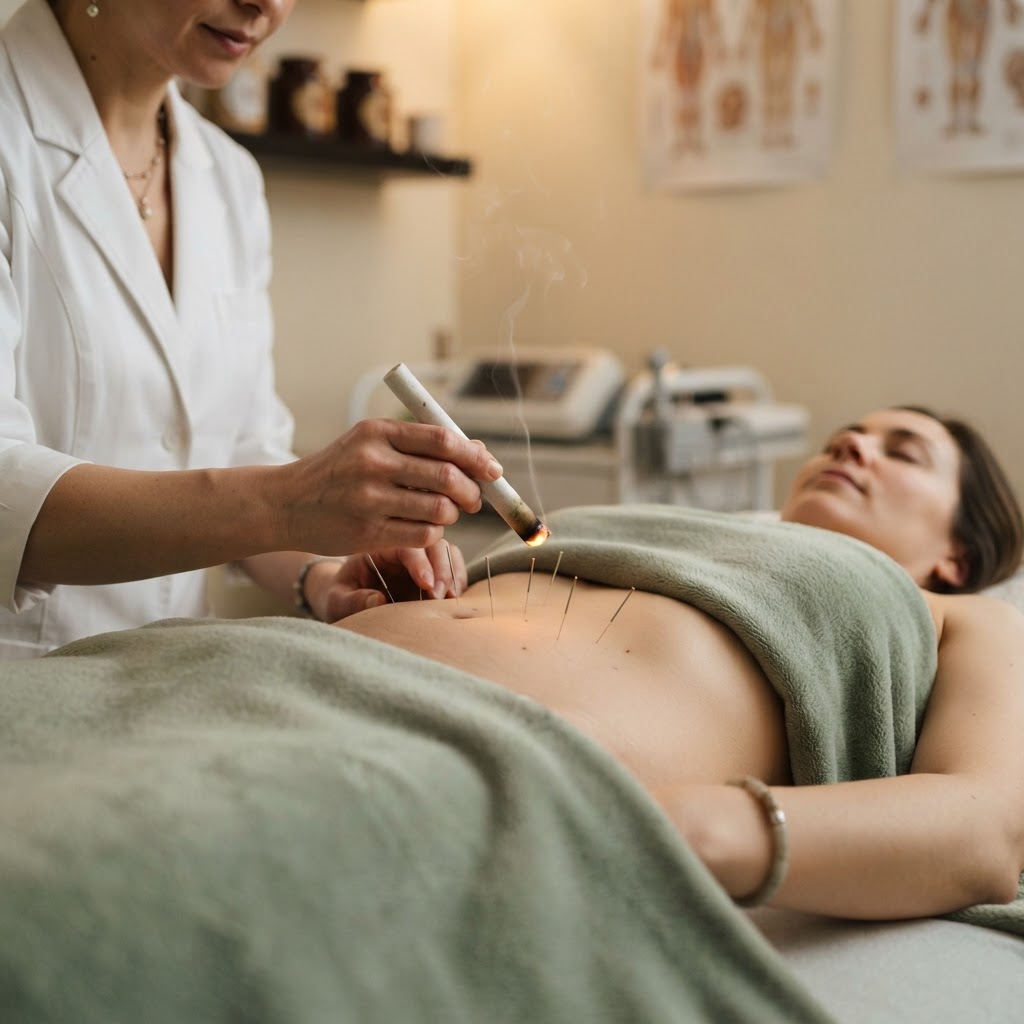
Depth, Angle, and De Qi, Without Losing the Patient's Trust
The insertion mechanics that decide whether the second session ever happens.

Cristiano Pires
TCM Practitioner · Author of "The Needle"

Quick summary
- De Qi is a signal, not a goal, chasing it aggressively costs retention.
- Insertion angle (perpendicular, oblique, subcutaneous) is dictated by anatomy, not preference.
- Depth is not linear across the body, chest, abdomen, and limbs have radically different safe ranges.
- The 'trust window' is the first 3 seconds of insertion; overshoot and you lose the patient.
Every acupuncture textbook teaches De Qi as the marker of a successful insertion. Every experienced practitioner knows the truth is more complicated: strong De Qi in the first session is often the reason a patient doesn't come back. The needle didn't miss, the relationship did.
De Qi is a signal, not a target
The classical texts describe De Qi as the arrival of Qi, a felt sensation of heaviness, distension, or radiating warmth at the point. Modern research correlates it with sensory nerve engagement and local connective tissue winding. But somewhere between the classics and today, De Qi became a performance metric. It shouldn't be. In the first session, a light, dull, barely-there De Qi is often the correct target. The strong grabbing sensation is for session five, not session one.
The 3-second rule
The first 3 seconds after insertion are the trust window. If the patient flinches, sighs, or vocalizes, you have already overshot, and the rest of the session will be spent recovering that trust rather than building it.
Angle: dictated by anatomy
Insertion angle is not a stylistic choice, it's a safety mechanism. Perpendicular insertion (90°) is safe over thick muscle and away from vital structures (LI4, ST36, SP6). Oblique (45°) is required near bone, blood vessels, and thin tissue (LU7, PC6, most facial points). Transverse / subcutaneous (10–15°) is essential over ribs (BL13, GB21) and for scalp acupuncture. Getting the angle wrong isn't just ineffective, over the chest wall, it's how pneumothoraces happen.
| Feature | Region | Safe angle & depth |
|---|---|---|
| Scalp (GV, extra points) | Transverse, 10–15° | 5–15 mm subcutaneous |
| Face (Yintang, ST4) | Oblique or transverse, 15–30° | 3–8 mm, never perpendicular |
| Anterior chest (ST, KI, LU) | Oblique 15–30° or transverse | 5–10 mm max, pneumothorax risk if deeper |
| Upper back (BL13–BL18) | Oblique toward spine, 30–45° | 10–15 mm, never perpendicular over lung field |
| Abdomen (CV, ST, KI) | Perpendicular | 10–25 mm depending on adiposity |
| Limbs (LI4, ST36, SP6) | Perpendicular | 15–30 mm, deepest safe zones |
The trust curve across sessions
Session 1: light insertion, minimal De Qi, short retention (15–20 min). Session 2: same insertion, mild De Qi, standard retention (25 min). Session 3 onward: full protocol depth and manipulation. This isn't 'watering down' the treatment, it's building the physiological trust that lets you deliver the full treatment without losing the patient at session 2.
This post covers about 20% of Chapter 4. The full chapter includes a region-by-region depth atlas (with anatomical illustrations), the manipulation technique escalation curve I use across a 10-session cycle, and the four insertion errors that account for 80% of adverse events in the acupuncture literature.
The takeaway
De Qi is a signal, read it, don't chase it. The angle is dictated by anatomy, negotiate it with the region, not with the pattern. And the depth is a conversation across sessions, not a single number. Get all three right and the second session becomes automatic.
TCM Clinical Pro annotates every point in your treatment plan with safe depth, angle, and manipulation guidance, indexed to the patient's biotype. Try it free for 14 days.
14 days free · No credit card required
Put this into practice
Run a full case through TCM Clinical Pro and get the complete differential, acupuncture protocol and herbal formula in under 3 minutes. Free for 14 days.