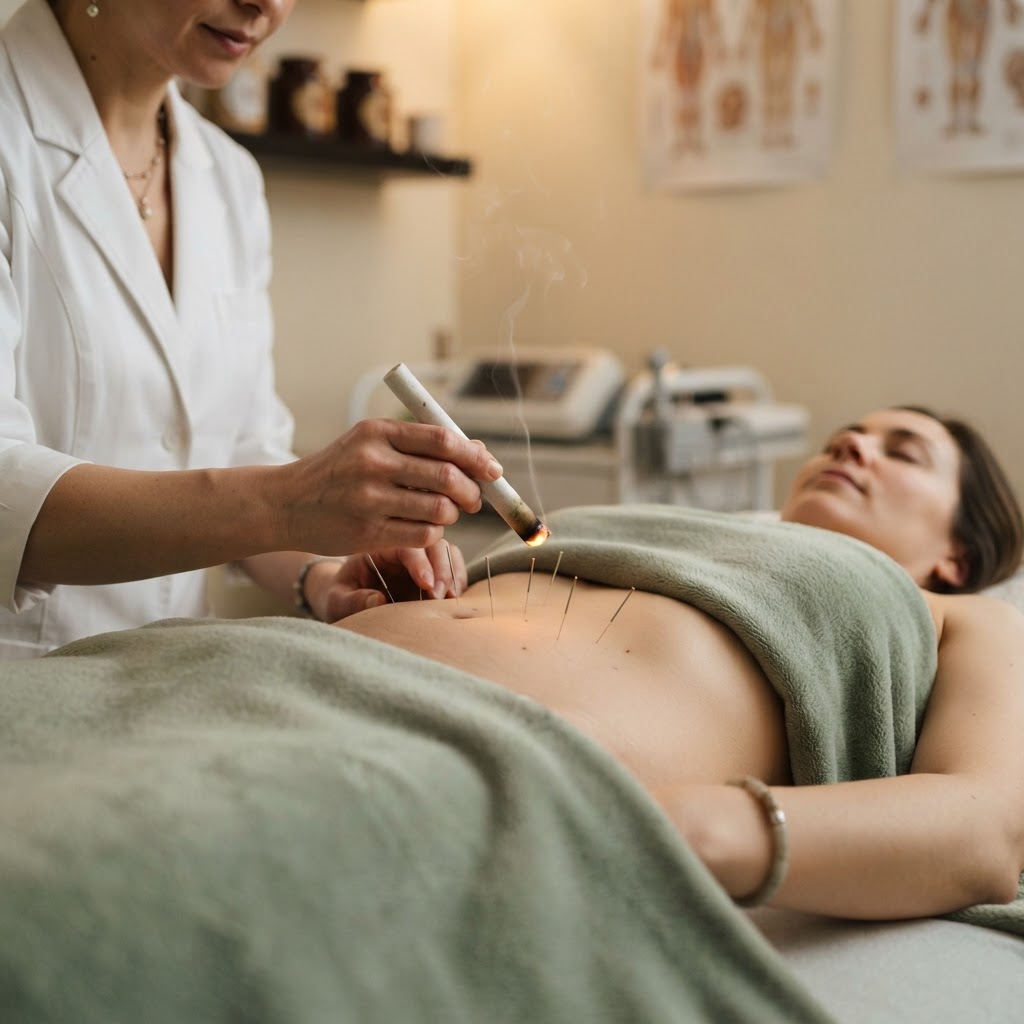
Read the Body Before You Reach for a Needle
How biotype, tissue density, and sensitivity should dictate your needle choice, not habit.

Cristiano Pires
TCM Practitioner · Author of "The Needle"

Quick summary
- The patient's body is the first variable, before pattern, before point.
- Muscular vs. adipose vs. asthenic biotypes each demand different needle depths.
- Sensitivity profiles override gauge choices, always assess before the first insertion.
- Age changes everything: elderly patients need shorter retention and finer gauges.
Most needle catalogs organize their products by length and gauge. That's convenient for stocking a clinic, and completely wrong for choosing what to insert. The variable that should drive the decision is sitting on your treatment table: the patient's body.
The three biotypes, and what each needs
Over the years I've settled on a simple triage: muscular, adipose, and asthenic. These aren't rigid categories, they're the first-pass filter I apply before I even open the needle drawer. Each biotype has predictable tissue depths, sensitivity thresholds, and manipulation tolerances.
| Feature | Biotype | Needle strategy |
|---|---|---|
| Muscular (athletic, dense tissue) | Deep points sit under thick muscle | 40–50 mm length, 0.30–0.35 gauge, strong De Qi tolerated well |
| Adipose (higher subcutaneous fat) | Superficial points buried under 1–3 cm fat | 50 mm length required for hip/glute points, 0.30 gauge for stability |
| Asthenic (thin, low muscle mass) | Every point is closer to the surface, and closer to nerve/vessel | 25–30 mm max, 0.20–0.25 gauge, gentle manipulation only |
| Pediatric | Extremely thin tissue layers, high nociceptor density | 15–25 mm, 0.16–0.18 gauge, retention 5–10 min max |
| Elderly (frail) | Thin skin, fragile capillaries, lower Yang | 25–30 mm, 0.20 gauge, no aggressive lifting-thrusting |
Sensitivity is not the same as pain tolerance
A patient who tolerates deep tissue massage can still be needle-averse, and vice versa. Sensitivity to acupuncture is a distinct axis: it's about nervous-system reactivity to a piercing sensation, not muscular pain threshold. Before the first session, I ask three questions: How do you handle blood draws? How do you feel about injections? Have you had acupuncture before, and how did you feel afterward? The answers reshape my needle selection more than any pattern differentiation.
The 'wired' patient
Patients with high sympathetic tone (anxiety, insomnia, hyperreflexia) often report insertion as sharp even with the thinnest needles. Reduce gauge, use Japanese-tip geometry, and consider superficial insertion only for the first two sessions.
Age changes the equation
Elderly patients aren't just 'smaller adults.' Their skin is thinner, their capillaries fragile, their Yang lower, and their recovery from over-treatment slower. Standard adult protocols, 30-minute retention, moderate stimulation, standard gauge, routinely overshoot in this population. My default for patients over 70: 20-minute retention max, 0.20–0.25 gauge, no more than 8–10 needles per session. You'll get better results with less.
This post covers the surface layer of Chapter 3. The full chapter includes a full body-type assessment protocol (5 minutes at intake), the sensitivity questionnaire I actually use in my clinic, and paired case studies showing how the same pattern (Liver Qi Stagnation) was treated three different ways across three different biotypes, with three different needle selections.
The takeaway
Choose the needle for the body before you choose the needle for the pattern. Pattern differentiation tells you where to insert; the body tells you what to insert. Reverse the order and you'll fight against the patient's tissue instead of working with it.
TCM Clinical Pro captures patient biotype, sensitivity profile, and age-related considerations at intake, and factors them into every needle specification it suggests. Try it free for 14 days.
14 days free · No credit card required
Put this into practice
Run a full case through TCM Clinical Pro and get the complete differential, acupuncture protocol and herbal formula in under 3 minutes. Free for 14 days.